Hi Everyone!!!!
Welcome to My Blog : ) '

วันเสาร์ที่ 1 ตุลาคม พ.ศ. 2554


                 Chapter 5 : Database

                                    Bitch, the (1958) [Novel]

                                          by Gil Brewer


                                      cover

                ...................

วันจันทร์ที่ 12 กันยายน พ.ศ. 2554

   Chapter 3

Comparison of Dewey and Library of Congress subject classification


This is a comparison chart showing how the Dewey Decimal and Library of Congress Classification systems organize resources by concept, in part for the purpose of assigning call numbers. These two systems account for over 95% of the classification in United States libraries, and are used widely worldwide.
The chart includes all ninety-nine second level (two-digit) DDC classes (040 is not assigned), and should include all second level (two-digit) LCC classes. Where a class in one system maps to several classes in other system, it will be listed multiple times (e.g. DDC class 551).
Additional information on these classification plans is available at:

Library of Congress Classification -- high level categories :The Library of Congress Classification (LCC) is a system of library classification developed by the Library of Congress. It is used by most research and academic libraries in the U.S. and several other countries, for example, Australi and Taiwan, R.O.C. It is not to be confused with the Library of Congress Subject Headings or Library of Congress Control Number. Most public libraries and small academic libraries continue to use the Dewey Decimal Classification (DDC).

EX, Class A - General Works

  • Subclass AC - Collections. Series. Collected works
  • Subclass AE - Encyclopedias
  • Subclass AG -Dictionaries and other general reference works
  • Subclass AI - Indexes
  • Subclass AM - Museums. Collectors and collecting
  • Subclass AN -Newpapers                                                                                                                                 Source : http://en.wikipedia.org/wiki/Comparison_of_Dewey_and_Library_of_Congress_subject_classification


Links to :
 
The Library of Congress 
= http://catalog.loc.gov/

The British Library         

Thai National Library    

Sripatum University Library 

Asean Community Website

วันจันทร์ที่ 5 กันยายน พ.ศ. 2554


Chapter : 2  Objective facts and   
                      Subjective opinion .


1. Objective facts


Ex : 
 Niagara Falls


  • Niagara Falls were formed as a result of glaciers receding at the end of the Wisconsin glaciation and water from the newly-formed Great Lakes, which together created a path through the Niagara Escarpment en route to the Atlantic Ocean. 
  • Although the Niagara Waterfalls are not exceptionally high, they are very wide. Their length of brink is 1060 feet while their height is 176 feet. Niagara Falls are one of the most powerful waterfalls in North America.
  • Niagara Falls are located on the international border that separates the Canadian province of Ontario and the American state of New York. 
  • Niagara Falls includes two major sections which are divided by the Goat Island. These two sections are the Horseshoe Falls, on the Canadian side and the American Falls on the United States side. One smaller section of the waterfall called the Bridal Veil Falls is also located on the American side and is separated from the main falls by the Luna Island.
  • One of the oldest and best known tourist attractions at the Niagara Falls is the boat cruise called Maid of the Mist boat cruise, which is named after an ancient Ongiara Indian mythical character.
  • The Niagara Falls had long been identified as a potential source of power. One of the very first attempts to utilize the Niagara Falls as a source of energy was in 1759. In 1759, Daniel Joncaire built a small canal above the waterfalls to power his sawmill. 
  • Augustus and Peter Porter later purchased this place along with the entire American falls in 1805 from the New York state government. Augustus and Peter Porter enlarged the original canal in order to provide hydraulic to power their gristmill and tannery.
  • In 1853, the Niagara Falls Hydraulic Power and Mining Company was chartered, which eventually constructed the canals that were to be used for electricity generation. In the year 1881, under the leadership of Jacob Schoellkopf, power was generated using the Niagara waters. The power was sufficient to illuminate both the Falls as well as the nearby Niagara Falls village.
  • It is a fact that the original Niagara Falls were near the sites of present-day Queenston, Ontario, and Lewiston, New York. However owing to the erosion of their crest, the waterfalls have retreated several miles southward.
  • Several people have attempted to conquer the Niagara Falls. In October 1829, Sam Patch, jumped from a high tower into the gorge below the falls and also survived the jump. This incident has continues into a long tradition of daredevils, some of whom successfully conquered the falls, while some even lost their lives in the attempt.
  • The number of tourists visiting the Niagara Falls in 2008 is expected to total 20 million. In addition to this, the annual rate is expected to top 28 million tourists per year by the year 2009. 
  Source :.http://www.buzzle.com/articles/facts-about-niagara-falls.html


2. Subjective opinion


EX....


I support the Niagara Parks Police Service. I have had the pleasure to have worked with the many fine members of the Niagara Parks Police on many occasions for more than three and a half decades. They are second to none when comparing police services within the Province. They are equal to any member of the NRP in training, ability, use of force and professionalism. They are armed as is any other police officer in the province.
Accountability has never been an issue until now because even though not governed by the SIU, they have always complied with all the rules regulations and general orders issued by NRP or the province. They are held accountable for their respective actions by NRP Police Services Board by virtue of securing their special constable status as well as being governed by the existing various federal and provincial statutes (i.e. Criminal Code of Canada etc). The SIU issue is not a new issue. It’s been around for a number of years and has
 not been overly problematic.            

With the sudden change of support and sponsorship of the Niagara Parks Police Service, I can't help but to think that the NRP Police Services Board has a hidden agenda or is empire building. Maybe they need a place for their overpriced and useless equestrian unit. I can see stables in the park already.
It seems that the NRP Police Services Board has a tendency to act like a rogue nation. It’s time for the dog to start wagging it’s own tail. The Government of the Province of Ontario needs to wake up, smarten up and take control before it’s too late. It is time for the government to revise the Police Services Act to bring all armed special constables under the SIU umbrella and to protect the right of existence of the Niagara Parks Police Service. Otherwise the citizens of Niagara and the millions of visitors from around the world will lose a valuable and highly recognized institution.
- Rick 10/04/28


Source : http://www.niagarafrontier.com/opinion.html 

 .........


Chapter :1 


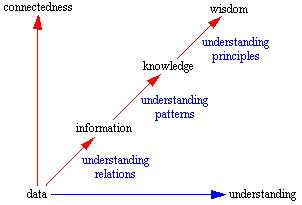
Data Information , Knowledge and Wisdom.


What is information?


 A systems theorist and professor of organizational change, the content of the human mind can be classified into five categories:


Data
  • - information, often in the form of facts or figures obtained from experiments or surveys, used as a basis for making calculations or drawing conclusions
  • information, for example, numbers, text, images, and sounds, in a form that is suitable for storage in or processing by a computer

Information

  • definite knowledge acquired or supplied about something or somebody
  • the collected facts and data about a particular subject
  • a telephone service that supplies telephone numbers to the public on request.
  • the communication of facts and knowledge
  • computer data that has been organized and presented in a systematic fashion to clarify the underlying meaning
  • a formal accusation of a crime brought by a prosecutor, as opposed to an indictment brought by a grand jury

Knowledge


  • general awareness or possession of information, facts, ideas, truths, or principles
  • clear awareness or explicit information, for example, of a situation or fact
  • all the information, facts, truths, and principles learned throughout time
  • familiarity or understanding gained through experience or study


Wisdom


  • the knowledge and experience needed to make sensible decisions and judgments, or the good sense shown by the decisions and judgments made
  • accumulated knowledge of life or in a particular sphere of activity that has been gained through experience
  • an opinion that almost everyone seems to share or express
  • ancient teachings or sayings


 Good and poor information.

 Good information is that which is used and which creates value. Experience and research shows that good information has numerous qualities.
Good information is relevant for its purpose, sufficiently accurate for its purpose, complete enough for the problem, reliable and targeted to the right person.  It is also communicated in time for its purpose, contains the right level of detail and is communicated by an appropriate channel, i.e. one that is understandable to the user. 

Poor information is irrelevant, swamping, unclear, not all threw. Because if you are have all of this in your information you may not make audience understand your information.


Source of information

"Source" means the origin of something. An information source is a source of information for somebody, i.e. anything that might inform a person about something or provide knowledge to somebody. Information sources may be observations, people, speeches, documents, pictures, organizations etc. They may be primary sources, secondary sources, tertiary sources and so on. Empiricism regards sense data as the ultimate information sources, while other epistemologies have different views


Primary sources

Primary sources allow researchers to get as close as possible to original ideas, events and empirical studies as possible. Such sources may include expositions of creative ideas, first hand or contemporary accounts of events, publication of the results of empirical observations or studies, and other items that may form the basis of further research. Examples include: 
  • Novels, plays, poems, works of art, popular culture
  • diaries, narratives, autobiographies, memoirs, speeches
  • Government documents, patents
  • Data sets, technical reports, experimental research results
Secondary sources

Secondary sources analyze, review or restate information in primary resources or other secondary resources. Even sources presenting facts or descriptions about events are secondary unless they are based on direct participation or observation. Moreover, secondary sources often rely on other secondary sources and standard disciplinary methods to reach results, and they provide the principle sources of analysis about primary sources. Examples include: 
  • Biographies
  • Review articles and literature reviews
  • Scholarly articles that don't present new experimental research results
  • Historical studies
Tertiary sources

Tertiary resources provide overviews of topics by synthesizing information gathered from other resources. Tertiary resources often provide data in a convenient form or provide information with context by which to interpret it. Examples include: 
  • Encyclopedias
  • Chronologies
  • Almanacs
  • Textbooks


Information Literacy
 
      The term information literacy, sometimes referred to as information competency, is generally defined as the ability to access, evaluate, organize, and use information from a variety of sources. Being information literate requires knowing how to clearly define a subject or area of investigation;
 
        Information literacy requires an awareness of the way in which information systems work, of the dynamic link between a particular information need and the sources and channels required to satisfy that need (Darch et al. 1997).   


 Information overload 

        Information overload is a description given to the phenomenon where so much information is taken in by the human brain that it becomes nearly impossible to process it. Alvin Toffler, an academic from Russia, is credited with coining the term. Since the term was first used, it has become very popular, especially in the computer age, though some say information overload
 is more a time and presentation issue, than an actual data issue.


Value of information
     The relative importance of information for decision-making can increase or decrease its value to an organisation. For example, an organisation requires information on a competitor’s performance that is critical to their own decision on whether to invest in new machinery for their factory. The value of this information would be high. Always keep in mind that information should be available on time, within cost constraints and be legally obtained. 

Users of information
       There are many kinds of information users in the modern word, not just personal users. They include users in...
            - Business and industry
            - Education
            - Research and development
            - Entertainment


What is mind map?
     
 A mind map is a diagram used to represent words, ideas, tasks, or other items linked to and arranged around a central key word or idea. Mind maps are used to generate, visualize, structure, and classify ideas, and as an aid to studying and organizing information, solving problems, making decisions, and writing.
The elements of a given mind map are arranged intuitively according to the importance of the concepts, and are classified into groupings, branches, or areas, with the goal of representing semantic or other connections between portions of information. Mind maps may also aid recall of existing memories.
By presenting ideas in a radial, graphical, non-linear manner, mind maps encourage a brainstorming approach to planning and organizational tasks. 
The mind map can be contrasted with the similar idea of concept mapping. The former is based on radial hierarchies and tree structures denoting relationships with a central governing concept, whereas concept maps are based on connections between concepts in more diverse patterns.
                    ___________________________________________________________
 Source :
                   http://en.wikipedia.org/wiki/Information_source 
                   http://www.libraryinstruction.com/infolit.html